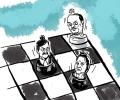
Sameer Buddha was just the kind of witness Indrani's lawyer Sudeep Pasbola dislikes. Someone, who had temporarily dumped his memory before entering the court. He answered most questions, one after another, one after another, one after another, with a monotonous, deadpan: 'I don't remember.' 'I don't remember.' 'I don't remember.'

When it came to his cross examination by Sanjeev Khanna's lawyer Niranjan Mundargi, Imtiaz Shaikh appeared to be afflicted by that peculiar gap-in-one's-memory or Choosy Memory Syndrome with his recall of other dates in his life, except those directly related with the murder, shaky or non-existent.

Something about the big car and its passengers, standing solemnly outside their vehicle, piqued the biker's interest.

Indrani called her personal assistant Kajal Sharma from the UK, May 3, 2012, and told her she had to sign Sheena's resignation letter as if she was Sheena signing it. But she had to first practice the signature and send Indrani proof of her proficiency in signing Sheena's name before sending the letter off. Sharma said she was reluctant and told the court that she told Indrani as much, but Indrani demanded it of her.

Singh and Badami subsequently took Waghmare to a corner of the corridor outside, where others have no access, and gave him a lecture. The conversation was largely inaudible, except for a phrase here or there. The thrust was unmistakable. Waghmare had to learn not to give such detailed answers to the defence.

She continued to cry, harder, feebly dabbed her eyes with the handkerchief she had received, and declared painfully: "He is hurting my emotions!"

Then came the electrifying climax of Tuesday's hearing. Pasbola showed Sharma copies of cheques that had been deposited at the bank with Indrani's signature on them. He accused Sharma of forging Indrani's signature and collecting the money for herself. In the back Indrani stood up in the accused box and very pointedly nodded her head up and down and mouthed, "She did!".

This week was the first time Peter and Indrani appeared in court no longer married, footloose and fancy free once again, even if in jail.
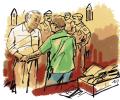
It will be his fifth birthday in jail as an undertrial. He was arrested two days before his birthday in 2015. Tuesday also marked Peter's fourth year in jail.

Sanjeev Khanna stepped out of his usual sort of absent-minded personality to actively 'log into' the hearing, following the testimony alertly, at times standing up in the accused box to catch all of what was being said. His co-accused Peter Mukerjea and Indrani Mukerjea were less attentive, but were not switched off either.

That answer, the strangest of all till date in this courtroom, set off a ripple of excitement, surprise and muted amusement among those present, including Accused No 1 Indrani Mukerjea.
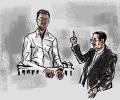
If an FIR had been registered by the Pen police -- instead of a mere entry in the station diary -- an investigation could have taken place and the body might have been identified as Sheena's, leading to the case being cracked much earlier.

Pasbola had a number of queries about the nails of the corpse found at Gagode Khurd. Did it have nails? Nails, in a case of strangulation, are key because they often have particles and skin beneath them to show the victim had been grasping something as s/he was strangled.

Finally to end the dispute, Sharma threatened to show her shoes. Pasbola declared regally that he would like to forgo that particular honour. Sharma ignored him. Instead, she bent down, took off her shoe and triumphantly held her prize aloft, and said delightedly, "Yeh dekhiye! (Have a look!)"

Mekhail hopped off the bench in a hurry and turning his back to Indrani, stood at the window. Indrani ignored him too. Mekhail is getting married later this year. His mother will, of course, not be in attendance. Nor, of course, would he want her to be there, if she could.

'I kept photographs of everyone. Because I was working for them.' 'Madam, Saab...' Shyamvar Rai, the approver in the case, said in a tone that tried to suggest that that would be a routine practice for a driver.

'I ask for bail in the name of justice.' 'Give me a chance to stay alive and see the trial till its end.'

'When the forensics have collapsed, approver is clearly proved to be a liar from the beginning to the end... Does the prosecution genuinely believe that we ought to remain in judicial custody despite showing that their own story is not being corroborated by evidence, for another 192 witnesses?'

Maruti Warke's basic understanding illustrated how far outside the system most less privileged Indians are -- simple, innocent people barely but admirably eking out an existence, with almost no knowledge of their surroundings or owning even the basic smarts to go about life. The same people who instinctively and often astutely vote governments into and out of office in New Delhi without knowing the entire reality of this country. The folks who are actually the essence of India.

Though on the face of it appeared Pasbola was asking a series of odd questions that would be difficult for anyone to answer, there was, it gradually emerged, it seemed, a method to the questioning. Somehow, somewhere instinctively, Pasbola knew there was something not right with Riyaz's account.

Devulkar had a certain abnormal vagueness about him that was unreal and defied belief. That came across in both his slightly too easy-going, extra-cooperative manner and the ragged nature of his testimony.
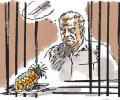
He was getting fruits, but no implement to cut them with. He told the judge, sadly: "I have tried and it is very difficult, your honour." His statement quickly brought up the imagery of Peter trying to cut a pineapple with his teeth or a papaya with a pen or a toothbrush.

It is not often that Goswami's Nation-Wants-to-Know shows become material evidence in a murder trial no less. Nor was it something CBI Special Judge J C Jagdale was wildly enthused about. It had to be done because as he put it to CBI Special Public Prosecutor Kavita Patil caustically: "Your witnesses gave interviews to channels about a serious crime."
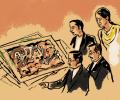
Many pictures showed The Skeleton Named Sheena. For the purpose of the photographs, the skeleton had been re-assembled and looked straight at the camera.

Indrani chose at that moment to wave a folded chit from the accused enclosure. It distracted Bharti, who looked at her sharply for a split second before turning back to Pasbola. The chit was collected from Indrani and her lawyer Gunjan Mangla slipped it to Pasbola. He looked at it, quietly laughed in disbelief and continued with his cross examination.

Shivade then asked if the skeleton finally came out of the ground in many parts. It was difficult not to gasp aloud at that revelation. Bhagat said that was true.

The warmest reception came from his soon-to-be ex wife Indrani, who on spying him getting out of the lift, muttered an "Oh dear!" and walked over to him, trailed by her police guards, wreathed in high-wattage smiles.

Pasbola wound up his cross examination, tabling a new narrative in the murder case. That Sheena Bora had been murdered not by her mother. But by her brother.

After ten minutes no one could keep track of the legal team's questions on the geography of the route Sandeep Patil took on his Pulsar Bajaj motorcycle, on the morning of April 25, 2012. Not the judge. Or the onlookers. Least of all Patil.

'After Indrani's arrest did you go to the police and say I did this kind of forgery?'

Will there be answers? Will we ever know the truth about who murdered Sheena Bora?

After 800 days, is it a little clearer that Accused No 1 through 4 are responsible for her death?

Ever since Indrani's bail plea was denied by the judge her security has been stepped up. The message was clear. If she felt that unsafe she could get all the security she needed. But in jail she stayed.

The ripping off the lid, that Mekhail did, on the chain of episodes that lead up to his sister's murder, while condemning Indrani for her actions, for the first time, paradoxically, allowed a more human -- if flawed and complicated -- picture to emerge of Indrani, allegedly The Woman Who Killed Her Own Daughter and shocked a nation.
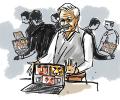
The software had, perhaps unknown to Dr Tripathi, tracked the changes he had made. The 'morph track' feature of the software provided a trail of what had been done and also indicated that the doctor had, it seemed, opted to morph Sheena's face with the provided skull, much in the same manner that Fantamorph can turn a woman into a cheetah.
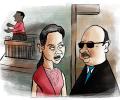
More noticeable than the hue of his shirt was his mast style in the witness box. He seemed to be reinventing the truth every few minutes. He yarned on and on, navigating his testimony further and further away from the facts, but he never lost his aplomb.

And then came the chief moment of Friday. If the courtroom had a soundtrack, Beethoven's 9th would be playing, providing a triumphant, dramatic prologue to the production of this last clip. A woman reporter was asking Mekhail about Sanjeev Khanna. He says clearly, without mincing words, emphatically: 'Never seen him. First time I am hearing his name.'

'You don't want to admit that it is your wife in the video because she said you were arrested on Wednesday (August 19; Shyamvar Rai states he was arrested on August 21, a Friday).'

Why had the CBI decided to have Waghmare tell the court the tale surrounding this odd trip to Kolkata made for even odder reasons, close to a year-and-a-half after Sheena's murder? To show the kind of person Indrani was? And that the murder of her daughter was not a heat of the moment crime, given Indrani was capable of other odd, suspicious, premeditated acts like this?

As he was giving evidence, Dr Matcheswalla peremptorily summoned the CBI representative over to the witness box and whispered something. Indrani Mukerjea's advocate Sudeep Pasbola immediately cut in, wondering what he was up to: "Please, please, please." Dr Matcheswalla, looking innocently startled, said: "I was asking if I can order for tea."
